Artists doing science. Scientists making art. I wish this article had come out two weeks earlier! Link includes:
-- "Victimless Leather"
-- the human digestive system reproduced via computerized vats
-- visualizations of SMS networks
-- a compiled list of modern-day exhibitions of art and science
NewScientist: CultureLab: Art Meets Science Enjoy!
Monday, May 10, 2010

Saturday, May 8, 2010
Something that has been an underlying theme as well as a constant anxiety for myself throughout the semester was expressed concisely by Ben in class on Thursday in light of Latour's Black Box idea. Within a black box we have achieved so much specialized knowledge that proves we do indeed know so much, yet it doesn't acknowledge all that we have forgotten. That all of our knowledge about life and human nature and sex and food and art and science is all seen through the lens of technology and our Cartesian reality. This certainty that we live by and dedicate our lives to is founded by empirical ideas that we have just taken as truth and formed our lives around. We live in the future, and are constantly analyzing how the past has formed us. The obsession with ontological commitment is deeply unsettling when considering the black box theory applied to history and how we decide we know...anything for that matter. The episteme of our age, or metaphysical platform, or technological chaos, or hybrid of ideas, whatever you want to call it, the context that new ideas from our time have been created is so removed from the triumphs and failures of thought that it took to get us where we are today that we have no doubt, as a species, forgotten so much.
With this being said in a very unclear manner, what I find deeply upsetting is the motivation behind education and learning and living life day to day. Everyone is so focused on some sort of goal, some sort of guarantee that they can count on with life. I am just as much of a culprit as the next person, but this class wasn't as shocking to my knowledge about things as it was for some. The irritation of ideas and facts about the way we know the world is awesome, as was expressed on the last day of class, but why is it then that all people are looking for out of an education is a job, is money, is x-y=z. Has it always been that way? Are we just placing our minds into a black box that is inescapable? I see it sort of like watching a tv that has someone watching something on tv and so on. I am in a large way extremely stuck by this notion of history being lost, of intellectual thought being harnessed by our historic context, by the black box of expression. We might be numbed to the most obvious necessities of our reality because the larger agenda that was here before us has put blinders on our ability to see clearly. With a Bachelor of Individualized Studies, CSCL ANTH ENGL, and much more in between I have thoroughly confused myself and said multiple times that I held more grounded opinions about the world 4 years ago than I do now. Maybe I should go do the whole science thing to figure out a way to reallllly understand the world, or something. . . . To end with a topic we didn't get into really, but a quote: Simply put, when there is no home birth in a society, or when home birth is driven completely underground, essential knowledge of women’s capacities in birth is lost to the people of that society—to professional caregivers, as well as to the women of childbearing age
themselves. ( Ina May Gaskin)
Friday, May 7, 2010
!
Crichton. Michael Crichton. After reading State of Fear, I don't think I'll be able to look at global warming the same again.
It's not because I think Crichton was a totally trustworthy source on the topic, though he knew much about it. But the book opened up discussion for us, the discussion about credibility and just where all of this shit comes from. This actually was one of the themes for our class...semantic contagion, black boxes, money... Now that we all have these terms to put on these cultural devices, it is easier to pick them out when they are happening. Instead of making the world more clear, however, it is as though we just put a name to all that complexity and ambiguity, so now we know how big it really is. That is something we talked about on the last day of class - how unsure of the world so many of us now are. Even before I came to this class, I was a person who hesitated to hold a firm position on some issues, just because I knew there was no way that I could possibly understand the complexity of them, and therefore would not be able to back my opinions up. This isn't to say that I don't have opinions, it's just that I am very careful. And now...Fie, fie!
The difference is that now I understand a little better what questions I need to be asking, most of which would be directed at the motives of any involved parties. Another reading that stood out to me this semester was the Carl Elliot piece about ADHD. It wasn't just about ADHD, though, it was about our capitalist consumer society in general. I found what he said to be disturbing, not just because what he said was gross to me but because the echo it threw around in my head was familiar - thoughts I had but had not quite thought. So much of American culture and so many of its movements in the last sixty years or so have gone hand-in-hand with consuming. Marketing to sell goods. Female equality increased cigarette sales. ADHD. Marking our identity by our jeans. The green revolution. Global warming...
Tough stuff. A bit disillusioning, but it's good for ya, right?
It's not because I think Crichton was a totally trustworthy source on the topic, though he knew much about it. But the book opened up discussion for us, the discussion about credibility and just where all of this shit comes from. This actually was one of the themes for our class...semantic contagion, black boxes, money... Now that we all have these terms to put on these cultural devices, it is easier to pick them out when they are happening. Instead of making the world more clear, however, it is as though we just put a name to all that complexity and ambiguity, so now we know how big it really is. That is something we talked about on the last day of class - how unsure of the world so many of us now are. Even before I came to this class, I was a person who hesitated to hold a firm position on some issues, just because I knew there was no way that I could possibly understand the complexity of them, and therefore would not be able to back my opinions up. This isn't to say that I don't have opinions, it's just that I am very careful. And now...Fie, fie!
The difference is that now I understand a little better what questions I need to be asking, most of which would be directed at the motives of any involved parties. Another reading that stood out to me this semester was the Carl Elliot piece about ADHD. It wasn't just about ADHD, though, it was about our capitalist consumer society in general. I found what he said to be disturbing, not just because what he said was gross to me but because the echo it threw around in my head was familiar - thoughts I had but had not quite thought. So much of American culture and so many of its movements in the last sixty years or so have gone hand-in-hand with consuming. Marketing to sell goods. Female equality increased cigarette sales. ADHD. Marking our identity by our jeans. The green revolution. Global warming...
Tough stuff. A bit disillusioning, but it's good for ya, right?
In the Middle
The issues, concepts, texts, etc. discussed in class led me to question my own belief system. I found myself going into debates with one opinion and coming out with another…sometimes I came out with no opinion at all. I didn’t know which side to take or what to believe. This is how I felt and STILL feel about the text, discussion, and debate revolving around apotemnophilia. I remember reading this text the week before class and wondering ‘what am I getting myself into?’ The issues in apotemnophilia that are unsettling for me are the ethics of cutting off a limb and whether or not I am convinced this is actually a disorder. I stood borderline throughout that whole debate. I find it fascinating (and disturbing) that there are websites and blogs all over the internet dedicated to this, that people feel as though a limb is not part of them.
What I am taking away from this course is a better knowledge, or more open to, what else is out there. I have found from this course that there is no right answer and the majority belief is not always the correct answer. Just because there is “scientific” evidence to back something up, doesn’t mean its right either. There are SO many ways of looking at the world, and more often than not more than one of those views is the right view…but more than that, sometimes none of those answers are right either. I liked the statement made in class that now I know more but understand less… which oddly enough is completely okay with me. Sitting in the middle is better than standing left field.
What I am taking away from this course is a better knowledge, or more open to, what else is out there. I have found from this course that there is no right answer and the majority belief is not always the correct answer. Just because there is “scientific” evidence to back something up, doesn’t mean its right either. There are SO many ways of looking at the world, and more often than not more than one of those views is the right view…but more than that, sometimes none of those answers are right either. I liked the statement made in class that now I know more but understand less… which oddly enough is completely okay with me. Sitting in the middle is better than standing left field.
Cartesian World
I'm not exactly sure if I was ever introduced to Rene Descartes before this class. Maybe, but I'm not sure. But I think one of the things that I'm taking away from this class is the idea of a cartesian world, and wondering what it would be like if our friend Descartes had never decided to sit down in his comfortable chair by the fire and contemplate his (our) world.
I mean, the cartesian grids, body-mind dualism, etc. etc. It makes me want to experience the world before Descartes. And it's hard to imagine, you know, because we live our lives influenced by this man, even though many of us (me, included, before this class) don't even know it!
I guess it kind of bothers me, but I intrigues me, as well. The idea that one man, with his thoughts alone, could create some sort of system that seems to be a part of our human nature more than just another human invention.
I guess I could say I'm taking a greater awareness of our cartesian world away with me. I'm more aware of it when I look at google maps, and I'm more aware of it when I wonder to myself whether my mind really is disconnected from my body. I've personally led a life under the belief that my mind and body will be disconnected when I die (ghost in the machine?) but that they are deeply connected as I live. I think a very simple explanation of this would be the following: when one feels depressed in the mind (sad, angsty, anxious, etc), does one not also feel it throughout the body?
I guess I realized that I was thinking about Descartes' meditations before I even knew who he was. Now that I know who he is, I may have better grounds on which to support my own opinions rather than grasping for something that might help to explain how I'm feeling.
From apotemnophilia to ADHD: The authority of labeling
There were many units during this semester that intrigued me and really got me thinking, so it is hard for me to just pick one part. I learned a lot this semester and acquired many new ways of thinking and seeing the world around me. One section that really seemed to interest me, and I still reflect on, was way back at the beginning when we were discussing apotemnophilia.
I think apotemnophilia intrigued me because I have always been interested in strange psychological disorders (if we even call this a disorder) and how it relates to and affects society. The first thing that caught my eye was just the idea that people wanted to cut off limbs from their body and would go to extreme lengths to do so. Why would anyone possibly want to lose a leg if they didn't have to? It's just so interesting to figure out people's reasoning behind this. Just this one thing, apotemnophilia, then opens all these doors to problems and discussions. Should this be considered a disorder? If it is a disorder, how should it be handled? Who gets the say as to whether surgery should be performed or not? What are the costs to society? etc.
The main things that I will be taking away from this class, and mainly this discussion, are who exactly has the authority to make decisions like as to what is normal or not (and what constitutes "normal" anyways?) for instance, and the whole idea of labeling and categorizing everyone and everything. Even though I may not have a definite decision on these problems, this class has gotten me to really think deeper about certain areas and topics. Who gets the right to make decisions? Society does. But really what does that even mean? This argument with authority also got brought up when we were discussing sexuality and hermaphroditism. I find it very interesting as to who gets to make the decisions about the gender of a baby, whether it is the doctor, parents or the individual. I am still deciding on this. I sometimes think that it is the individual, but other times it might seem impractical to wait until an individual is of age. The other idea that I will take away and continue to ponder is the topic of labeling. In society we feel the need to label and categorize everything. It adds order and makes things more understandable and stereotyped. Why is this necessarily a good thing? I do not think that it is necessarily the best idea to label everything in society, because it just sets things apart and degrades people. This not only gets brought up with apotemnophilia, with labeling people as having a disorder or having a psychological problem, but also with the poster project on ADHD. Society feels the need to find answers and solve everything. "Oh, your child is hyper and can't focus? He has ADHD. You should drug him." It seems crazy to me. Why do we have to always turn to medicine or names to fix everything? Overall though, I will take away this idea of society and how certain people are said to have the authority to make decisions, and also how we need everything to have a label. Is this really how we want to live? I don't know, but what I do know is that I still have a lot of thinking to do and this class sparked many arguments for me.
I think apotemnophilia intrigued me because I have always been interested in strange psychological disorders (if we even call this a disorder) and how it relates to and affects society. The first thing that caught my eye was just the idea that people wanted to cut off limbs from their body and would go to extreme lengths to do so. Why would anyone possibly want to lose a leg if they didn't have to? It's just so interesting to figure out people's reasoning behind this. Just this one thing, apotemnophilia, then opens all these doors to problems and discussions. Should this be considered a disorder? If it is a disorder, how should it be handled? Who gets the say as to whether surgery should be performed or not? What are the costs to society? etc.
The main things that I will be taking away from this class, and mainly this discussion, are who exactly has the authority to make decisions like as to what is normal or not (and what constitutes "normal" anyways?) for instance, and the whole idea of labeling and categorizing everyone and everything. Even though I may not have a definite decision on these problems, this class has gotten me to really think deeper about certain areas and topics. Who gets the right to make decisions? Society does. But really what does that even mean? This argument with authority also got brought up when we were discussing sexuality and hermaphroditism. I find it very interesting as to who gets to make the decisions about the gender of a baby, whether it is the doctor, parents or the individual. I am still deciding on this. I sometimes think that it is the individual, but other times it might seem impractical to wait until an individual is of age. The other idea that I will take away and continue to ponder is the topic of labeling. In society we feel the need to label and categorize everything. It adds order and makes things more understandable and stereotyped. Why is this necessarily a good thing? I do not think that it is necessarily the best idea to label everything in society, because it just sets things apart and degrades people. This not only gets brought up with apotemnophilia, with labeling people as having a disorder or having a psychological problem, but also with the poster project on ADHD. Society feels the need to find answers and solve everything. "Oh, your child is hyper and can't focus? He has ADHD. You should drug him." It seems crazy to me. Why do we have to always turn to medicine or names to fix everything? Overall though, I will take away this idea of society and how certain people are said to have the authority to make decisions, and also how we need everything to have a label. Is this really how we want to live? I don't know, but what I do know is that I still have a lot of thinking to do and this class sparked many arguments for me.
I like to eat, eat, eat...APPLES AND BANANAS!
I've had the good fortune to have taken a class very similar to this one in my very first semester here at the U. (And it, too, was a CSCL class!) It strikes me as a little ironic that I would have the opportunity to face the same conundrums again when I am three years older.
To be certain, the study material was certainly different. I learned a great deal about myriad new subjects during the course of this semester, but one that stood out for me personally was the food unit--I find the process behind what's getting crammed down my gullet as I sprint to my next class both interesting and a little scary. Yeah, I know McDonald's isn't good for me, but if I have some fajita veggies from Chipotle I'm getting some good nutrition right? (Aaaaand the answer is no.)
The politics behind our food is a fascinating and unsettling subject, but any knowledge on the matter is good knowledge. It allows me the ability (if not the motivation) to make better decisions about what I chow down. Specifically, I enjoyed the portion of the Omnivore's Dilemma with Joel Salatin and his Polyface farms. I consider the implications of eating 'locally'...Minnesota has a rich variety of possible foodstuffs right in our "backyard"--surely I could live a more environmentally friendly life by eating our stuff and not having to have food shipped in for me from faraway lands. Salatin understands and incorporates the 'local' principle as part of his farmstead practice. His website specifically states: "..We do not ship food. We should all seek food closer to home, in our foodshed, our own bioregion. This means enjoying seasonality and reacquainting ourselves with our home kitchens..."
So unless I find myself in Virginia's Shenandoah Valley at some point in my wanderings, I shall never taste Joel Salatin's delicious turkey. I guess I can live without that. But what about oranges? I like oranges. And figs. Darn it, I like white rice. And bison meat. (If you've never had a bison burger, I HIGHLY recommend it!) And as Robin might say, "And, and, and..."
So I continue my omnivorous diet, fully aware of the potential for havoc I wreak by that decision. Someday, if I decide to go local, I'll have to reconcile that with the idea that I might be helping put some Florida citrus producer out of work. So what I'm taking from the class is the lesson that our most inane actions have real and unintended consequences. We need to make ourselves okay with the decisions we make, or change them. No choice is entirely without potential damage--and we need to be okay with that too.
Have a great semester, omnivores!
To be certain, the study material was certainly different. I learned a great deal about myriad new subjects during the course of this semester, but one that stood out for me personally was the food unit--I find the process behind what's getting crammed down my gullet as I sprint to my next class both interesting and a little scary. Yeah, I know McDonald's isn't good for me, but if I have some fajita veggies from Chipotle I'm getting some good nutrition right? (Aaaaand the answer is no.)
The politics behind our food is a fascinating and unsettling subject, but any knowledge on the matter is good knowledge. It allows me the ability (if not the motivation) to make better decisions about what I chow down. Specifically, I enjoyed the portion of the Omnivore's Dilemma with Joel Salatin and his Polyface farms. I consider the implications of eating 'locally'...Minnesota has a rich variety of possible foodstuffs right in our "backyard"--surely I could live a more environmentally friendly life by eating our stuff and not having to have food shipped in for me from faraway lands. Salatin understands and incorporates the 'local' principle as part of his farmstead practice. His website specifically states: "..We do not ship food. We should all seek food closer to home, in our foodshed, our own bioregion. This means enjoying seasonality and reacquainting ourselves with our home kitchens..."
So unless I find myself in Virginia's Shenandoah Valley at some point in my wanderings, I shall never taste Joel Salatin's delicious turkey. I guess I can live without that. But what about oranges? I like oranges. And figs. Darn it, I like white rice. And bison meat. (If you've never had a bison burger, I HIGHLY recommend it!) And as Robin might say, "And, and, and..."
So I continue my omnivorous diet, fully aware of the potential for havoc I wreak by that decision. Someday, if I decide to go local, I'll have to reconcile that with the idea that I might be helping put some Florida citrus producer out of work. So what I'm taking from the class is the lesson that our most inane actions have real and unintended consequences. We need to make ourselves okay with the decisions we make, or change them. No choice is entirely without potential damage--and we need to be okay with that too.
Have a great semester, omnivores!
Power struggle
All of the units we covered incorporated some issue that really stuck with me, so choosing one thing that changed how I observe world is hard. But a common idea that I saw linking each unit - from corn to sex change to medical disorders to global warming - was that each actions are never free from constraint or consequence.
This problem doesn't excite me so much as bother me. After reading A Brave New World, I realized that although we as humans aren't being fed soma and micro-managed to the point of brainwashing, Mustapha Mond exists in our world in other forms. And sometimes, we are selves take his role. While studying intersex issues, it became clear that we can't always choose our own sexuality. Parents put a gender label on their children, and those children may or may not be okay with it down the road. Global warming information can be altered or misconstrued by both sides, resulting in books like Crichton which influences popular belief. The food we buy can support commodity corn and the military industrial complex, and consequently affect the environment, the government, and farmers.
I've begun to grapple with free will as a result. Am I making my own choices, or are invisible constraints of politics, culture, and society making them for me? Or, on the other side, how are my choices affecting things that aren't inherently or immediately apparent? I've become more considerate and more careful when examining the things I buy and consume, and my personal beliefs. This class has taught me to never take things at face value, even my dinner. That may sound pessimistic or cynical, but I think its positive. To be aware of the invisible structures that shape the world makes me feel that I have a little more control over my actions because I understand how and why they come about.
science as a religion
Lewontin et al's Not In Our Genes -- I spent so much time reading this paper. I had heard the word bourgeoisie before but never in any sort of context (have yet to read The Communist Manifesto) so it was fascinating to learn through the lens of science studies where exactly this thing we now call "science" came from. Of course we haven't always had scientists, we used to have natural philosophers, but I'd simply never realized that there had to be a major shift of consciousness at some point.
I had heard quite a few times "Oh, science isn't any more trustworthy than religion. I have a belief in God, you have a belief in Science." I'd scoffed at such a claim before, thinking it had no basis (If I believe in science, at least there's evidence to back me up... ha) but maybe there was a hint of truth in there.
From Not In Our Genes: "[A]ny attempt to revolutionize society must use ideological counterweapons that deprive the old order of its legitimacy and at the same time build a case for the new." I highlighted, underlined, and wrote "YES" in all caps beside this. Scientists have fostered an ideological replacement of rule-by-objectivism for rule-by-divinity, which they claim is legitimate because the scientific method leaves no room for subjective error. (o rly?) My favorite sentence from Lewontin's paper: "The characteristic of science ... is that it is an activity of a special group of self-validating experts: scientists."
I've learned from our class how to read really critically and watch out for that old "argument from authority" fallacy; as a hard science major I had been overlooking or ignoring it when it came from fellow scientists whom I otherwise respected. I also feel more determined to continue on with one of my favorite pastimes, skepticism, since everything we covered in class provides ample justification: there's a LOT of bullshit going on in the world that I didn't even know or think about before.
But the most important thing I've drawn from this cultural studies class is the concept of a science-society "hybrid." Science is inseparable from social relations, no matter how many times the phrase is repeated "science is objective!" I'd brushed off before claims that science is akin to religion; no supernatural stuff is going on in the lab (that's what science sets out to disprove) and the findings don't require blind faith to accept. Skepticism is healthy, and not only do scientists get to claim something is bullshit and refute it through using the scientific method, we also must call out all suspicious statements or actions of theirs, and refute claims using a scientist's favorite tool: logic. The fallacy isn't "argument from authority (unless it's scientific authority)."
I had heard quite a few times "Oh, science isn't any more trustworthy than religion. I have a belief in God, you have a belief in Science." I'd scoffed at such a claim before, thinking it had no basis (If I believe in science, at least there's evidence to back me up... ha) but maybe there was a hint of truth in there.
From Not In Our Genes: "[A]ny attempt to revolutionize society must use ideological counterweapons that deprive the old order of its legitimacy and at the same time build a case for the new." I highlighted, underlined, and wrote "YES" in all caps beside this. Scientists have fostered an ideological replacement of rule-by-objectivism for rule-by-divinity, which they claim is legitimate because the scientific method leaves no room for subjective error. (o rly?) My favorite sentence from Lewontin's paper: "The characteristic of science ... is that it is an activity of a special group of self-validating experts: scientists."
I've learned from our class how to read really critically and watch out for that old "argument from authority" fallacy; as a hard science major I had been overlooking or ignoring it when it came from fellow scientists whom I otherwise respected. I also feel more determined to continue on with one of my favorite pastimes, skepticism, since everything we covered in class provides ample justification: there's a LOT of bullshit going on in the world that I didn't even know or think about before.
But the most important thing I've drawn from this cultural studies class is the concept of a science-society "hybrid." Science is inseparable from social relations, no matter how many times the phrase is repeated "science is objective!" I'd brushed off before claims that science is akin to religion; no supernatural stuff is going on in the lab (that's what science sets out to disprove) and the findings don't require blind faith to accept. Skepticism is healthy, and not only do scientists get to claim something is bullshit and refute it through using the scientific method, we also must call out all suspicious statements or actions of theirs, and refute claims using a scientist's favorite tool: logic. The fallacy isn't "argument from authority (unless it's scientific authority)."
Impacts of CSCL 3331.1
I really enjoyed this class as I do all CSCL classes. It's always so interesting to study the complex components of culture, but it's even more intriguing when it's compared and/or correlated with science. This is what I particularly appreciated when I consider the benefits of this class. The intervention project took this concept t0 even a higher level. It's so important to recognize the concept of hybridization within our lives. It encourages us to not only acknowledge, but understand the fact that issues within our lives have to be considered and viewed from a multi-dimensional point of view. I will admit that this class exposed me to such a diverse way of thinking. It allows you to see the world in such a different light.
This class really gave an insightful perspective of how our society longs to quantify and categorize everything into it's own little place, whether it be by race, gender, image, disorder, IQ, etc...I think that it's important that we don't get caught up in such a black and white way of thinking when we live in such a gray world. Even if it's continually stressed that there is only 2 sexes, we must learn to acknowledge and accept the possibility of the in-between. Nothing is concrete or promised, the world is constantly changing around us.
The poster project did a great job of illustrating all the diverse components within our world. It was so interesting to observe how groups were able to descend to a deeper level of thought and really analyze why and how are society has gotten to where it is today; there always is a process, its just easier to acknowledge the result instead. The posters were really successful in conveying the idea that culture and science are actually more closely related then one would think.
They are actually dependent upon each other, and that's why it's so imperative that we recognize, acknowledge, and consider this notion when it comes to everything we do, value, or approve of. And just like our poster of the Great Pacific Garbage Patch attempted to convey: the accumulation of LITTLE, less noticeable things can have a HUGE impact on not only our lives, but the entire world; so consider and weigh ALL the options with an open-mind because our perception is just ONE out of a billion realities that our universe is composed of.
This class really gave an insightful perspective of how our society longs to quantify and categorize everything into it's own little place, whether it be by race, gender, image, disorder, IQ, etc...I think that it's important that we don't get caught up in such a black and white way of thinking when we live in such a gray world. Even if it's continually stressed that there is only 2 sexes, we must learn to acknowledge and accept the possibility of the in-between. Nothing is concrete or promised, the world is constantly changing around us.
The poster project did a great job of illustrating all the diverse components within our world. It was so interesting to observe how groups were able to descend to a deeper level of thought and really analyze why and how are society has gotten to where it is today; there always is a process, its just easier to acknowledge the result instead. The posters were really successful in conveying the idea that culture and science are actually more closely related then one would think.
They are actually dependent upon each other, and that's why it's so imperative that we recognize, acknowledge, and consider this notion when it comes to everything we do, value, or approve of. And just like our poster of the Great Pacific Garbage Patch attempted to convey: the accumulation of LITTLE, less noticeable things can have a HUGE impact on not only our lives, but the entire world; so consider and weigh ALL the options with an open-mind because our perception is just ONE out of a billion realities that our universe is composed of.
little things huge impacts
The thing that intrigued me most about this course is how things that might seem very little to us can have huge impacts on society or on the world, or on a human life.
Before this course i was always very skeptical of things i did being able to affect the world on a macro level. If my target bag flew away i would try to get it yes but if i wasnt able to i would say oh well it's just one bag. Now i know that it's that "just one bag" that affects the whole world. Same with global warming, i would think that the world is so big the things i do couldnt possible have an effect on the world.
This goes beyond pollution, with intersexed children the choice the parents make at the time most likely doesnt seem as big of a decision as it ends up being. This one choice will greatly affect their child's life for the rest of their lives. This can also be seen with addiction, trying that drug that one time can lead to a lifetime of addiction.
I now know that i just have to realize what im doing and the affect it can have. Just being knowledgeable is a great start. If i know the effects of the little things i do or the possible affects i can change the damaging things and hopefully help the world and environment a little bit at a time. If everyone then went and had this attitude the world would be a much better place.
Before this course i was always very skeptical of things i did being able to affect the world on a macro level. If my target bag flew away i would try to get it yes but if i wasnt able to i would say oh well it's just one bag. Now i know that it's that "just one bag" that affects the whole world. Same with global warming, i would think that the world is so big the things i do couldnt possible have an effect on the world.
This goes beyond pollution, with intersexed children the choice the parents make at the time most likely doesnt seem as big of a decision as it ends up being. This one choice will greatly affect their child's life for the rest of their lives. This can also be seen with addiction, trying that drug that one time can lead to a lifetime of addiction.
I now know that i just have to realize what im doing and the affect it can have. Just being knowledgeable is a great start. If i know the effects of the little things i do or the possible affects i can change the damaging things and hopefully help the world and environment a little bit at a time. If everyone then went and had this attitude the world would be a much better place.
Thursday, May 6, 2010
Mindful Reading
After taking this class, I have found that I am much more conscious of what I read. Whether this is pleasure reading or scientific reading, I am constantly thinking about the “footnotes”. Even if there are not footnotes, I have learned that in order to be a conscious reader, you must do some background work on the topic, author, etc. Especially in scientific literature, I am quick to consider and look into any outside agendas of the research. Is this a source that I can trust; What is the company funding the research; What background does the author come from. These are all great questions to consider when reading and I think that this helps you get the most out of the piece of work you are reading.
In general, I think that this virtue I have been handed as being a student in CSCL 3331: The Sciences and the Humanities will only help me. I believe that being cautious as to what I believe as being true is a great asset to have, especially as a person of the sciences. As Matt mentioned, it may make you slightly paranoid. Does it personally make me more paranoid? A little, but I believe it is beneficial to be educated on all the aspects that affect each word written on the page. We have seen many times how each word seems to have been intricately chosen by the author in order to get a point across, support a cause, refute evidence… the list could go on and on.
I thought it was especially interesting to hear classmates quoting their parents: “ignorance is bliss” and “the more you know, the less you understand”. I think both of these are very true in their own way. As educated human beings, we are more able to contradict an idea presented with other knowledge we have acquired. This is the source of many heated debates, some of which we have witnessed in class. Knowing more does make everything a little more complicated and it is sometimes hard to separate all this in your head at once. But, the more you know doesn’t always correlate to understanding less. I think this can be true in some cases but isn’t always true. I think that being able to apply your knowledge allows you to truly understand what you know and this application process is the what makes the knowledge “stick”.
During my group’s presentation of global warming, there seemed to be a debate on what to believe. There are so many different ideas about the causes of global warming and even if the global warming crisis actually exists or if it is just a natural process of the Earth. With my research for the project, it seemed that each site had their own set of data supporting their “idea” of what is right. On the first day of a statistics class I took, we learned about how statistics can be used to support just about anything you want it to. Correlation does not mean causation and the global warming data is a perfect example of this.
All in all, I don’t know if I will ever be able to “fun” read again without thinking hmm… I should look up the bio on this author and see what he or she is involved with / associated with… my summer reading list recently became much more interesting!
Thank you for a great semester!
In general, I think that this virtue I have been handed as being a student in CSCL 3331: The Sciences and the Humanities will only help me. I believe that being cautious as to what I believe as being true is a great asset to have, especially as a person of the sciences. As Matt mentioned, it may make you slightly paranoid. Does it personally make me more paranoid? A little, but I believe it is beneficial to be educated on all the aspects that affect each word written on the page. We have seen many times how each word seems to have been intricately chosen by the author in order to get a point across, support a cause, refute evidence… the list could go on and on.
I thought it was especially interesting to hear classmates quoting their parents: “ignorance is bliss” and “the more you know, the less you understand”. I think both of these are very true in their own way. As educated human beings, we are more able to contradict an idea presented with other knowledge we have acquired. This is the source of many heated debates, some of which we have witnessed in class. Knowing more does make everything a little more complicated and it is sometimes hard to separate all this in your head at once. But, the more you know doesn’t always correlate to understanding less. I think this can be true in some cases but isn’t always true. I think that being able to apply your knowledge allows you to truly understand what you know and this application process is the what makes the knowledge “stick”.
During my group’s presentation of global warming, there seemed to be a debate on what to believe. There are so many different ideas about the causes of global warming and even if the global warming crisis actually exists or if it is just a natural process of the Earth. With my research for the project, it seemed that each site had their own set of data supporting their “idea” of what is right. On the first day of a statistics class I took, we learned about how statistics can be used to support just about anything you want it to. Correlation does not mean causation and the global warming data is a perfect example of this.
All in all, I don’t know if I will ever be able to “fun” read again without thinking hmm… I should look up the bio on this author and see what he or she is involved with / associated with… my summer reading list recently became much more interesting!
Thank you for a great semester!
How Can They Think That?!?!?!
1) The most valuable thing that I learned in this class was, there is a reason that people think and act the way that they do and it is important to understand what shaped their perspective so that I can judge my own.
2)The reason that understanding people's subjectivity is so crucial is because once I am able to see what has shaped them I can more accurately see what has shaped me. I used to think that if someone's beliefs didn't match up with mine they were biased (by choice or birth) by something in their thought process, making their opinion illegitimate. An example would be religion; if someone was to base their actions and opinions off of the bible I would call them a god fearing dumbass, but now I am starting to see that in their subjectivity, living by the bible is the only plan of action. When I spot things like religious bias I start to see my own bias'; non-religious, young, white, male, American, middle class, strait, etc. My metaphor is, its like going to the zoo and looking in every exhibit with curiosity instead of walking down a hallway of closed doors. Once I am able to see that I am shaped by so many external stimuli, the lines between who's right and who's wrong start to blur.
3) This has altered my actions with the world by instead of disregarding people with "abnormal" actions of beliefs, I now want to know more about what they think/do. This won't always change what I think, but I learn a lot more about the world and the people in it when I listen instead of talk. This played out in class mainly during our stint with apnotemnophilia. We all thought that these people were crazy, but when you see the number of people with the same desire the right and wrong fence starts to get some holes in it. Being open to ideas that contradict my core convictions and assumptions creates a multitude of new life paths that are available to me.
Blog posting #10 (due FRIDAY 5/7, 11:59 P.M. (comment due SATURDAY 5/8, 11:59 P.M.)): Final reflection/discussion
This last post is real open...and meant as a kind of final reflection/discussion. We'd like you to do the following:
1) Choose one thing from this class (a text, an issue, a concept, an object, a theme, a case study, etc.) that you are taking away with you from this class -- something that still excites you, or bothers you, or intrigues you. Ideally, something that has changed, even in some small way, the way that you see and act in the world.
2) Describe it, briefly: what it is, and why it excites/bothers/intrigues you.
3) Reflect on what about it you are taking away from this class, and how it has (in whatever way) altered your thoughts about and actions in the world. If possible/appropriate, make reference to how the issue played out in class discussion, in the context of other topics/issues/themes/texts/concepts/cases we have been dealing with. If you recall what one or two of your colleagues had to say about it, bring that in too!
1) Choose one thing from this class (a text, an issue, a concept, an object, a theme, a case study, etc.) that you are taking away with you from this class -- something that still excites you, or bothers you, or intrigues you. Ideally, something that has changed, even in some small way, the way that you see and act in the world.
2) Describe it, briefly: what it is, and why it excites/bothers/intrigues you.
3) Reflect on what about it you are taking away from this class, and how it has (in whatever way) altered your thoughts about and actions in the world. If possible/appropriate, make reference to how the issue played out in class discussion, in the context of other topics/issues/themes/texts/concepts/cases we have been dealing with. If you recall what one or two of your colleagues had to say about it, bring that in too!
Tuesday, May 4, 2010
ADHD and PETA/WWF
From what I saw today in class I gathered that ADD seems to be pretty over-diagnosed. Maybe 'over-treated' is better word choice. Regardless, I think we all see the sketchiness in creating a disease because we have a known cure for it. We have the treatment, people will buy it, now all we have to do is find a condition and blow it up so we can make revenue!
By the same token, organizations like PETA pound us with scare tactics to try and get our sympathy and sincere concern. This slowly turns into money from our wallets. I'm not saying PETA is lying to us, but I'm also not saying they're telling us the truth. But they have to make money somehow, right?
So what exactly is going on here? It just looks like capitalism to me, really. I mean, it's the way our country runs. You can't sell a product unless there's a need. If there's no need for it, then you create the need. Once the need is created in the people you just let consumerism take it's course. You're kid is too hyper for school? Now you can buy his focus for him! Feel guilty about the dying polar bears? Well, now you can buy your guilt off!
But is this really fixing anything? And if it isn't why do we keep feeding these phony causes? It's because we're born into these paradigms....If doctors are always diagnosing your kids then they're probably always right. They have a PHD and therefore can't be swayed by money. And Sue's kid from across the street has it, so it's normal if my kid has it too (semantic contagion anyone?). And they treat him with drugs so it's probably normal for me to do it too. PETA is a huge, respectable organization so they can't be doing shady things like killing off all their stray animals. Plus they're all hippies and animal-lovers so none of them care about money!
Not to get all "every-human-is-innately-evil" on you, but it does seem like all these companies care about, despite their noble intentions, is just getting a few bucks. I'm sure not everyone that works for them is trying to rip you off, but the way the system works sure does suggest it. Maybe if we all stepped out of these paradigms and really looked at the world we might be able to stop these scams before they become these huge powerful organizations.
FDA Food Safety Modernization Act
Is anyone in our working group used to reading legal speak? I am trying to wade through these food bills and I am having a heck of a time.
Dr. Shiv Chopra (bio) an Indian-Canadian health whistleblower who has written much like Michael Pollan about how businesses' corruption of government endangers our food supply, has said the bill "would preclude the public’s right to grow, own, trade, transport, share, feed and eat each and every food that nature makes. It will become the most offensive authority against the cultivation, trade and consumption of food and agricultural products of one’s choice. It will be unconstitutional and contrary to natural law or, if you like, the will of God."
This is the working text of the Senate bill
This is the working text of the House bill
Dr. Shiv Chopra (bio) an Indian-Canadian health whistleblower who has written much like Michael Pollan about how businesses' corruption of government endangers our food supply, has said the bill "would preclude the public’s right to grow, own, trade, transport, share, feed and eat each and every food that nature makes. It will become the most offensive authority against the cultivation, trade and consumption of food and agricultural products of one’s choice. It will be unconstitutional and contrary to natural law or, if you like, the will of God."
This is the working text of the Senate bill
This is the working text of the House bill
Adam T on addictions and prisons
Over the course of the poster presentations, it was interesting to note the similarities in presentation and subject matter as well as public response to the posters of Addiction and Prison. The Prison presentation was a little clearer in how people are selected to be housed in prisons. When you commit an act that is outlined in a body of law as unlawful, you have the potential of being hauled off to prison. In Addiction’s presentation, to be labeled an addict depended on conflicting criteria, ranging from genetic theories to psychoanalytic principles. This contrasts to criminality, where the label criminal depends upon a black and white outline of legal/ illegal. However, what was similar between the two posters was where each presentation outlined theories (past and present) commenting on prevention of each topic. Each poster presented ways in which to treat addiction and actions of illegality; embedded in theories of treatment is that of prevention. It was interesting to note that genetics has supplied rhetoric to both topics in their commentary on prevention and cause.
Another aspect talked about was the monetary factor that surrounded prison and addiction. There is plenty of money spent and profited in both realms. What was very interesting was the discussion taking place during the Q&A part of the presentation. There were more than a few comments made that attached “industrial complex” to the end of each topic, using the oft-quoted “military industrial complex” model to espouse the possibility that science was being produced so as to benefit certain entrepreneur. Maybe this is the conspiracy theory template that will replace UFO’s, assassinations, and government cover-ups.
Robin--for Adam Tapper (whom Blogger seems to hate and won't let him post)
Another aspect talked about was the monetary factor that surrounded prison and addiction. There is plenty of money spent and profited in both realms. What was very interesting was the discussion taking place during the Q&A part of the presentation. There were more than a few comments made that attached “industrial complex” to the end of each topic, using the oft-quoted “military industrial complex” model to espouse the possibility that science was being produced so as to benefit certain entrepreneur. Maybe this is the conspiracy theory template that will replace UFO’s, assassinations, and government cover-ups.
Robin--for Adam Tapper (whom Blogger seems to hate and won't let him post)
Monday, May 3, 2010
Image Addicts
It's very interesting how important ones' image has become in the society that we live today. It seems as though physical perfection has become the ultimate goal of our modern day culture. Plastic Surgery is raging more than ever, anorexia and bulimia are at their highest, and parents are even trying to create the physically perfect baby. It's seems as though one's image is directly correlated with their identity. But how could it not? Well with all the marketing and consumerism, it should be a given. What perplexes me is the fact that people take it so far as to put themselves in physical danger to alter a part of their body that's perfectly healthy. It might not be a "normal" nose within the realm of culture specifications, but it does everything a nose should. This longing for perfection has had both a negative and positive effect on culture. People have decided to get in shape, if it wasn't for all the obesity and fast food today, would the dieting producers even have a spot to advertise? It all seems like an elaborate plan to me.
It seems like we are wasting all this time and energy and stressing ourselves out in order to attain this cultural specific defintion of "perfect." The task just becomes an obstacle in the routine of our lives. If we could see through the muniplulation and redirect that extra energy into productive life improvements as oppose to image, just imagine the capabilites. You only live once, why beat yourself up trying to attain the impossible?
It seems like we are wasting all this time and energy and stressing ourselves out in order to attain this cultural specific defintion of "perfect." The task just becomes an obstacle in the routine of our lives. If we could see through the muniplulation and redirect that extra energy into productive life improvements as oppose to image, just imagine the capabilites. You only live once, why beat yourself up trying to attain the impossible?
Tragic Necessities: Cosmetic Surgery and Designer Babies
My apologies for the late post-- as the semester draws to a close, my stress levels go through the roof and my migraines become more frequent, which certainly makes studying a bit more difficult.
Our society does not accept that some afflictions will inevitably befall a certain percentage of our population. We want to fix it; we want to make the playing field equal for those afflicted as those who are not. Unfortunately, there will always be those with the resources to use those same means to make the playing field uneven again.
Cosmetic surgery was not always a method for the vain. The practice likely began with the Roman Empire, who used simple reconstructive surgical methods to repair war wounds among its fighting men, such as repairs to damaged earlobes. Cataract surgery and rhinoplasty have their origins here, (though they certainly differ from the gentler procedures we know of today!), and in the nineteenth century, advances in sterile technique allowed repairs to cleft palates, mastectomies, and skin grafts. With the advent of WWI, damage wrought by more modern weapons brought about even more advances in surgery. Soldiers returning home with disfiguring facial injuries or chemical burns were operated on so they could look much as they did before shipping out--how could we allow them to suffer the rest of their lives after they had already sacrificed so much?
This mindset persists when one thinks about many of the common congenital illnesses that afflict our newborn children as well-- if we are able to select for genes that are "healthy", we can prevent them from having to experience Huntington's Chorea, or Phenylketonuria; diseases that will cut our beloved children's lives short. Naturally, these tools (and all tools, really) can be used for controversial purposes as well as for those universally accepted as "good". Because we entrust the parents as the ultimate authority on what is good for their child, the parents may choose to screen their child for traits we would never allow for our own children. Deaf child? Dwarf child? If one can select it out, one can select it in.
So who makes the call as to whether these tools are being used for good or evil? Society likes to make such calls; but it is not society who gets to choose the use for the tools in the first place. This dissonance goes to the very heart of biopolitics, with constantly shifting societal moral codes determining which applications of biotechnology are "good", and which are "bad". Facial reconstruction for a war veteran to allow him to breathe normally again? Good. Facial reconstruction for a celebrity who wants a prettier nose and plump lips? Bad. Genetic screening for PKU? Good. Screening for blue eyes? Bad.
Ultimately, society will be dragged kicking and screaming into a future where the status quo no longer applies. The implications of our newfound power to choose not to allow Huntington's disease to run rampant also paves the way for the more questionable practices to take place, and it is the rich who will nearly always benefit first and most, for they have the means necessary and the resources to make such decisions while the rest of the proletariat are stuck allowing nature to take its course. We struggle to even the playing field, but the playing field can never truly be even.
Our society does not accept that some afflictions will inevitably befall a certain percentage of our population. We want to fix it; we want to make the playing field equal for those afflicted as those who are not. Unfortunately, there will always be those with the resources to use those same means to make the playing field uneven again.
Cosmetic surgery was not always a method for the vain. The practice likely began with the Roman Empire, who used simple reconstructive surgical methods to repair war wounds among its fighting men, such as repairs to damaged earlobes. Cataract surgery and rhinoplasty have their origins here, (though they certainly differ from the gentler procedures we know of today!), and in the nineteenth century, advances in sterile technique allowed repairs to cleft palates, mastectomies, and skin grafts. With the advent of WWI, damage wrought by more modern weapons brought about even more advances in surgery. Soldiers returning home with disfiguring facial injuries or chemical burns were operated on so they could look much as they did before shipping out--how could we allow them to suffer the rest of their lives after they had already sacrificed so much?
This mindset persists when one thinks about many of the common congenital illnesses that afflict our newborn children as well-- if we are able to select for genes that are "healthy", we can prevent them from having to experience Huntington's Chorea, or Phenylketonuria; diseases that will cut our beloved children's lives short. Naturally, these tools (and all tools, really) can be used for controversial purposes as well as for those universally accepted as "good". Because we entrust the parents as the ultimate authority on what is good for their child, the parents may choose to screen their child for traits we would never allow for our own children. Deaf child? Dwarf child? If one can select it out, one can select it in.
So who makes the call as to whether these tools are being used for good or evil? Society likes to make such calls; but it is not society who gets to choose the use for the tools in the first place. This dissonance goes to the very heart of biopolitics, with constantly shifting societal moral codes determining which applications of biotechnology are "good", and which are "bad". Facial reconstruction for a war veteran to allow him to breathe normally again? Good. Facial reconstruction for a celebrity who wants a prettier nose and plump lips? Bad. Genetic screening for PKU? Good. Screening for blue eyes? Bad.
Ultimately, society will be dragged kicking and screaming into a future where the status quo no longer applies. The implications of our newfound power to choose not to allow Huntington's disease to run rampant also paves the way for the more questionable practices to take place, and it is the rich who will nearly always benefit first and most, for they have the means necessary and the resources to make such decisions while the rest of the proletariat are stuck allowing nature to take its course. We struggle to even the playing field, but the playing field can never truly be even.
Sunday, May 2, 2010
Crime Junkies
From what I was told about people who commit crimes by the prison presentation, they like instant gratification, aligning this statistic with the fact of drugs giving instant gratification after ingestion, what is the black box of self-destructive behavior and instant gratification. There is a DARE program in every middle school in America, yet millions of American's do drugs. If knowing the consequences and possible out comes of drug use why is it that people still partake in drug use. Crimes also give the offender instant gratification most of the time; stealing, mugging, selling drugs. Instant gratification relates to basic need satisfaction; eating, sex, sleep. All of these make you happier faster relative to putting money in a retirement fund or studying, which pay off later. When something can make a person feel better instantly after the act there is some kind of primal reward that humans thrive on. Be it a chemical in the brain or a reinforcement of self image, most self-destructive behavior is the result of activities with instant gratification
Plastic surgery could be the next frontier of cleanliness that the human race crosses as our economic well being increases. Freud suggested that beauty as a measure of value is an important aspect of a civilization. In our current time period soap is in abundance, but it has not always been that way. As civilizations advanced, standards of personal hygiene skyrocketed. It cleanliness and beauty products have always advanced and become more widely available in wealthy cultures. A product or procedure will be introduced to the market, and at first only rich people can afford to use it, but eventually it becomes used by most people. over the last 20 years plastic surgery has become much cheaper, more accepted, and of higher quality. Once it is cheap enough for the regular person to afford, will it become expected like shaving or make up?
Additction to perfecting the person
A common theme I noticed in many of the poster presentations was an infatuation our society has with perfecting the person, whether it is through designer babies, or cosmetic surgery in many different perspectives for accentuating physical features, or to take a personal disadvantage such as bad eyes and enhancing them to a cyborg state of precision. When is enough enough, where do we draw the line, and who gets to draw this line? Looking at the growing number of people that have cosmetic surgery and many that go back for more than one it seems that we are nowhere near drawing that line. Rather it seems like sooner than later there are going to be a lot of human Frankenstien's running around. While we can make physical changes to our bodies today, with the new hype of the designer baby, it seems as though we will be making these changes before the next generation even has a beating heart. But where are these additions taking us? Before you know it the olympics won't even be fun to watch because everyone will be the fastest, strongest, and best at whatever it is they desire.
We are creatures of habit, and wanting to be the best is only natural, but the line between habit and addiction is a very fine line. We know that a boob job today, lasic eye surgery tomorrow are popular procedures that don't seem problematic. But we don't know what could come from the technology of the designer baby. Is it something that we should consider stopping before it gets out of hand and we have created armies of perfect humans or is it something that will be legitimized like birth control, with a clear enough blurry line, not knowing exactly what is going on with the hormones besides the fact that it protects women from getting pregnant.
We are creatures of habit, and wanting to be the best is only natural, but the line between habit and addiction is a very fine line. We know that a boob job today, lasic eye surgery tomorrow are popular procedures that don't seem problematic. But we don't know what could come from the technology of the designer baby. Is it something that we should consider stopping before it gets out of hand and we have created armies of perfect humans or is it something that will be legitimized like birth control, with a clear enough blurry line, not knowing exactly what is going on with the hormones besides the fact that it protects women from getting pregnant.
Addiction...leads to designer babies.
There is a remarkable trend between many of the presentations we saw. People are always trying to “better” their lives (for better or for worse). There are the plastic surgery recipients, who are bettering their appearance and self-esteem by making the incisions. We also have the enhancements made in sports and industry, which are becoming the best in their fields by whatever means it takes. There are also the recipients (or potential recipients) of IVF and genetic screening to create their “designer baby.” There are also those who use animal testing to put the best products on the market. And finally, we have the addicts… who may be addicted to drugs to better their feelings, or may be addicted to plastic surgery to become the best they physically can, or addicted to perfection…to create the baby of their dreams. The connection I would like to make is between addiction and designer babies. I think the majority of poster presentation, as I stated previously, have emphasized the desire to be the best by whatever means possible. And I think that designer babies are more extreme of them all. We no longer are going to become the best… we are going to be born the best. Instead of having things on the market, like lasic eye surgery, or facial cream, or hair dye, or colored contacts to make us the best that we chose to be, we are going to chose for our children what the best is. Our society has this excessive problem with addiction and it shows up in almost every aspect of our lives. It seems like all of the addiction that exist in our society have led up to this idea that we can create the baby that we want. That we should no longer suffer from the gifts our genes give us but create our own. Addiction is everywhere.
Genetic Eugenics
The two posters that I think have an interesting relationship are Incest and Designer Babies, because, well, they both obviously deal with the idea of reproduction, but not the reproduction with which most of us are familiar; it's not just about making babies, but making "better" babies, whether it be through the alteration of genetic make-up or keeping the prized traits free from "outside" blood. These ideas are essentially the backbone of modern eugenics (and the eugenics from the early twentieth century, as well) because they're both based on the idea that we can keep people pure, or we can create them to be pure, in order to relieve the human race of dysgenic traits. As we know, though, inbreeding can create the opposite effect, causing people to be born with certain defects caused by recessive or deleterious traits.
Although, when speaking of incest, I am speaking more of civilizations where it is socially appropriate (or even necessary) to breed with close relatives, rather than the equally taboo subject of incest as a form of sexual abuse.
It's a very interesting idea to think that we have, are, and will continue to find ways to legitimize selective breeding through methods other than simply choosing the partner with the most desirable traits, because duh, you or your partner might have an undesirable trait that you wouldn't want passed along to little junior, why not find a way to change that? You see, inbreeders had the right idea: scientists and concerned citizens just had to come up with a less taboo way of making the perfect human happen. It's almost as if human genetic engineering is new kind of incest, or rather, the future of incest, a new, intellectually and socially accepted form of genetic purification. It's truly fascinating, I think, and the sky really seems like the limit when speaking of the future of genetic eugenics. The only difference that I see behind the main ideas of human genetic engineering and incest is the fact that, in HGE, the preferred trait need not come from a close relative--no, in fact it can come from someone you've never met before. I mean, who has heard those stories of babies having two mothers and one father? This may in fact be the future of the upper class, and even for the lower class as well, once the technology becomes more accessible.
Scary? Sure. Possible? Oh, yeah. Likely? Something tells me yes.
Thinking Inside of the Box
Snakes eating alligators, quarks, earthworms, and total world destruction...though it may not seem so, I think that the topics of Invasive Species and the Hadron Collider share more than this nonsense juxtaposition.
First, yes, there are differences. The Hadron Collider is through and through a product of men, a tool to grasp our universe (and others?) better than Robert Boyle or Lord Kelvin could have thought. Invasive species, or (euphemistically and situation-specifically called) "introduced species" are mechanisms that are/were implemented by men intentionally and accidentally, even carelessly.
Still, there are parallels between these two topics. Both involve the "black box". I would say, however, that the black boxes in these situations are a little different than in more straightforward examples (e.g. using soap and noting a decrease in deaths during childbirth but not knowing why). It seems to me that the black box rests more at the end of these processes. Or maybe, it is as if when using these actions - introducing species & running particles into each other - we exist inside of a black box, not being able to see out. Perhaps you might say, concerning the Hadron Collider, that it would be an attempt to see inside the black box that is the mystical and fundamental structure of the universe, or inside a quark...but in a narrower sense, I am talking about how scientists just don't know exactly what is going to go down in 2012 when those little dudes bump into each other. In this way, my two topics are related. People had no idea what the repercussions would be of introducing plants and animals into new habitats. We have a better idea now: the new species could potentially destroy the native ecosystem. We know this, but we still don't completely understand ecosystems.
That reminds me of Michael Crichton and global warming. People have been industrializing and doing all of this stuff for years without thinking about the possible problems of the future. Now we are only aware that changes are happening, but have yet to iron out the details. Weather is a wild and unpredictable animal. . . just like the animals and plants that have been introduced throughout history. And those species, to our dismay, had much harmful potential that we could and cannot control. And what about the Collider? Boom! Big Bang II? Blackhole? Nothing?
As people, the crazy, curious, prodding, overbearing, and often careless creatures that we are, we have big plans and many desires. Those desires might be transporting a few of our favorite game animals to our new home continent to shoot for sport, or they might be shooting particles at each other in order to unroll the space-time continuum. Constantly, the human species is trying to go further, to excel, solve puzzles, validate theories, to conquer and stick its opposable thumb in more plum pies than it can handle. I'm not saying humans are all bad, I'm just pointing to some of the traits that humans (those in a position to do so, anyway) share. On top of the black box, this is one more thing that these two topics have in common: they are products and byproducts of the inquisitive human brain.
First, yes, there are differences. The Hadron Collider is through and through a product of men, a tool to grasp our universe (and others?) better than Robert Boyle or Lord Kelvin could have thought. Invasive species, or (euphemistically and situation-specifically called) "introduced species" are mechanisms that are/were implemented by men intentionally and accidentally, even carelessly.
Still, there are parallels between these two topics. Both involve the "black box". I would say, however, that the black boxes in these situations are a little different than in more straightforward examples (e.g. using soap and noting a decrease in deaths during childbirth but not knowing why). It seems to me that the black box rests more at the end of these processes. Or maybe, it is as if when using these actions - introducing species & running particles into each other - we exist inside of a black box, not being able to see out. Perhaps you might say, concerning the Hadron Collider, that it would be an attempt to see inside the black box that is the mystical and fundamental structure of the universe, or inside a quark...but in a narrower sense, I am talking about how scientists just don't know exactly what is going to go down in 2012 when those little dudes bump into each other. In this way, my two topics are related. People had no idea what the repercussions would be of introducing plants and animals into new habitats. We have a better idea now: the new species could potentially destroy the native ecosystem. We know this, but we still don't completely understand ecosystems.
That reminds me of Michael Crichton and global warming. People have been industrializing and doing all of this stuff for years without thinking about the possible problems of the future. Now we are only aware that changes are happening, but have yet to iron out the details. Weather is a wild and unpredictable animal. . . just like the animals and plants that have been introduced throughout history. And those species, to our dismay, had much harmful potential that we could and cannot control. And what about the Collider? Boom! Big Bang II? Blackhole? Nothing?
As people, the crazy, curious, prodding, overbearing, and often careless creatures that we are, we have big plans and many desires. Those desires might be transporting a few of our favorite game animals to our new home continent to shoot for sport, or they might be shooting particles at each other in order to unroll the space-time continuum. Constantly, the human species is trying to go further, to excel, solve puzzles, validate theories, to conquer and stick its opposable thumb in more plum pies than it can handle. I'm not saying humans are all bad, I'm just pointing to some of the traits that humans (those in a position to do so, anyway) share. On top of the black box, this is one more thing that these two topics have in common: they are products and byproducts of the inquisitive human brain.
Addiction and Plastic Surgery
Who should have the power to control what you do to your body or what you decide to put into your body? Similar to deciding to chop off your appendages as Elliot discussed, cosmetic plastic surgery is an elective procedure. (note: there is a difference between reconstructive plastic surgery- corrects functional impairments- and cosmetic plastic surgery- provides enhancement of appearance)As a popular conclusion in class, elective surgery should not be covered by insurance. Should plastic surgery be regulated by the government or the doctor? In my opinion, a good doctor would suggest that the person see a psychologist before deciding to operate perpetually on a patient. To me, this would be the “best” thing for the patient. But this relates back to who is in charge of your body. Also, if one doctor refuses to perform a procedure on a person, there will always be another doctor who will perform the operation (their motives obviously being money and not the well-being of the patient). When a person is continually having procedures, I believe there is obviously an underlying problem but every person has a right to their own body. It is hard to see where the line should be drawn, if at all. On the same note, who is to say you should not do drugs (a major issue in the addiction topic). Is it good for you? No, but there are so many things that are bad for us and still legal. Examples: McDonalds, cigarettes, and alcohol.
Addiction to plastic surgery is one of many things one can be addicted to. There are countless patients who many would consider to be obsessed with plastic surgery. Tabloids are always exploiting the latest celebrity plastic surgery case. As humans, we are obsessed with classifying. Classifications of addiction such as sex, alcohol, and substance abuse are present in the DSM. I could not find an “official” addiction to plastic surgery but I can only imagine that this will become a “term” in the near future due to our obsession of classifying.
Perfect example of person addicted to cosmetic plastic surgery:
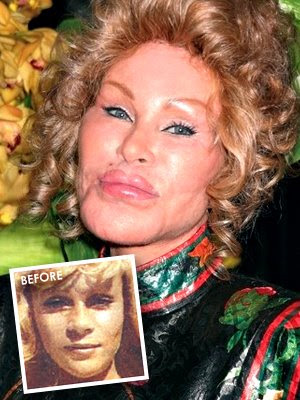
Addiction to plastic surgery is one of many things one can be addicted to. There are countless patients who many would consider to be obsessed with plastic surgery. Tabloids are always exploiting the latest celebrity plastic surgery case. As humans, we are obsessed with classifying. Classifications of addiction such as sex, alcohol, and substance abuse are present in the DSM. I could not find an “official” addiction to plastic surgery but I can only imagine that this will become a “term” in the near future due to our obsession of classifying.
Perfect example of person addicted to cosmetic plastic surgery:
Choosing Our Children
The ideas and implementation of designing our children using technology and using birth control are very similar. Birth control lets us decide when we want to have kids. It makes it convenient for the wanna-be parents so they are able to create the very best environment for the child that they want to raise, or to make sure that their relationship is sound. Genetically modifying our children lets us choose the characteristics of our children by either selecting screened embryos or changing our child's genes.
I guess what i am getting at here, is whether birth control and genetically modifying our children are two different things, or the same thing. Both technologies let the parents or wanna-be parent decide some type of fate for the future child. Whether we selected the specific genes for the child or decide when the child will be born its the same concept of modifying the natural process of child bearing. I'm not saying that these technologies and ideas are bad or wrong, or right for that matter, but im just saying that they are alot more closely linked than i had thought.
The idea of birth control and designer babies can be linked back to the idea of eugenics. Margret Sanger, who was influential in the mass production of birth control was also a big eugenicist. Im looking at these two concepts through the same seeing device. Even though, in today's society they might not be seen in such a way, I feel like designer babies and birth control are very similar.
I guess what i am getting at here, is whether birth control and genetically modifying our children are two different things, or the same thing. Both technologies let the parents or wanna-be parent decide some type of fate for the future child. Whether we selected the specific genes for the child or decide when the child will be born its the same concept of modifying the natural process of child bearing. I'm not saying that these technologies and ideas are bad or wrong, or right for that matter, but im just saying that they are alot more closely linked than i had thought.
The idea of birth control and designer babies can be linked back to the idea of eugenics. Margret Sanger, who was influential in the mass production of birth control was also a big eugenicist. Im looking at these two concepts through the same seeing device. Even though, in today's society they might not be seen in such a way, I feel like designer babies and birth control are very similar.
prisons and Incest
Both the Incest and the Prisons are drastically changed from time to time and place to place. In some cultures incest is completely acceptable while in others its the worst sin/crime/act imaginable. Same goes for crime, in some cultures what is punishable by death is not wrong at all in others. This brings everything to the point of is it wrong because we say it's wrong or do we say it's wrong because it is actually wrong. Do we punish because someone breaks the law or do we punish because we believe what they did was wrong.
Scientists are trying to prove that incest causes babies to be disfigured and dimented so that they can say yes incest is wrong and this is why its wrong. What if there unable to prove it, or there findings and disproved, what then? If we cant use science to prove incest is wrong do we accept it? Do we switch from science to religion to help prove our thoughts? Lots of cultures are totally fine with incest and even view it as "pure" is it society that views incest and murder as wrong or is it actually wrong.
Once the question is asked one must decide how to answer it. Is it enough to use people opinions as law or do we need something more. Must incest be proven unnatural in some sort of way to be considered wrong or is society viewing is as wrong enough to stabalize this thought. Same goes for crime, should crimes need to be proven wrong in some way to be illegal? Murder is taking a life, it is unfair and basically is easy to prove it's wrongness, but how could we prove the wrongness of smoking weed? It's said to be safer than legal drugs like alcohol. Should it be scientifically proven to be more harmful than other legal substances before one illegalizes it? Basically the question is why do some societies view things as right when others view them as wrong?
Scientists are trying to prove that incest causes babies to be disfigured and dimented so that they can say yes incest is wrong and this is why its wrong. What if there unable to prove it, or there findings and disproved, what then? If we cant use science to prove incest is wrong do we accept it? Do we switch from science to religion to help prove our thoughts? Lots of cultures are totally fine with incest and even view it as "pure" is it society that views incest and murder as wrong or is it actually wrong.
Once the question is asked one must decide how to answer it. Is it enough to use people opinions as law or do we need something more. Must incest be proven unnatural in some sort of way to be considered wrong or is society viewing is as wrong enough to stabalize this thought. Same goes for crime, should crimes need to be proven wrong in some way to be illegal? Murder is taking a life, it is unfair and basically is easy to prove it's wrongness, but how could we prove the wrongness of smoking weed? It's said to be safer than legal drugs like alcohol. Should it be scientifically proven to be more harmful than other legal substances before one illegalizes it? Basically the question is why do some societies view things as right when others view them as wrong?
Birth Control vs Designer Babies
On the one hand we have Birth Control: women can prevent a pregnancy by means of a little pill, shot, plastic hormone-containing ring, or small metal device. On the other we have Designer Babies: if women are going to reproduce, they ought to make the highest quality kids that science can produce!
As far as we know, how birth control (specifically the Pill) works its hormonal magic is a black box, perhaps intentionally so. If we don't know whether the Pill prevents an egg from even being viable, or if it frustrates/prevents implantation of a zygote, society can't clearly condemn it as immoral (based on the widely held belief that causing the death of a weeks-old embryo is in effect killing a fully grown baby). Good thing for womankind that this science is as yet unknown, because once society decides something is immoral it becomes much harder to get at, and women might hesitate to take black market birth control. All we know about birth control is its name of action: if you take the Pill, a little tablet full of a bunch of synthetic hormones, you probably don't get pregnant. Through different trials the Pill shows varying levels of effectiveness, e.g. if you don't take it at the same time everyday you might discover one day you are pregnant.
No black box w.r.t. designer babies. Take some gametes from mom and dad, combine them and grow some embryos, then throw away the defective ones and implant some of the remaining, more perfect embryos. The name of the action is cancer/disease/etc in what used to be a healthy person, but it doesn't happen to everybody; the trials through which the actant goes are gene sequencing of many healthy, sick, and "cured" humans to see if their illnesses correspond to their genetics; and the actants are specific parts of genes identified as potentially life-threatening because they signify susceptibility to illness. If an embryo's genes contain those actants they are considered defective and their growth is terminated.
Designer babies give some of us a much more uneasy feeling than birth control -- not only are we now able to play god by deciding exactly when a woman should become pregnant, but we can make the baby better, faster, stronger! It's legitimate to want to restore your baby to some sort of normative standard of health, because no one likes to think of a sickly, unhappy infant or know that their child might die of a preventable illness. But if you want to create a Superbaby (or a Deaf baby) your motivation and rationalization fall under serious scrutiny and will probably be seen as trying to advance your personal ideology by creating children in your image of perfection.
One of the cons of GE babies is overpopulation, but even though the designed humans will likely live longer overpopulation may be prevented. Women who want to reproduce can use birth control to prevent pregnancy while she works hard to earn money and/or a husband. Once she's acquired enough capital to have a secure and stable home, she can pay someone to design her baby so that it's (at minimum) genetically equal to everyone else's. Competition through reproduction! It's expensive, so most women won't be able to have more than a couple of babies this way, and hopefully if they invest all this money in their creation they'll be even more interested in the kid once it's out of the womb, and provide it with a well-rounded education. This MUST include comprehensive sex education, don't care if it comes from the parents or from the schools. That way kids won't accidentally get pregnant -- they'll follow in the footsteps of their parents, which will over time lead to population stabilization, all other factors remaining equal.
As far as we know, how birth control (specifically the Pill) works its hormonal magic is a black box, perhaps intentionally so. If we don't know whether the Pill prevents an egg from even being viable, or if it frustrates/prevents implantation of a zygote, society can't clearly condemn it as immoral (based on the widely held belief that causing the death of a weeks-old embryo is in effect killing a fully grown baby). Good thing for womankind that this science is as yet unknown, because once society decides something is immoral it becomes much harder to get at, and women might hesitate to take black market birth control. All we know about birth control is its name of action: if you take the Pill, a little tablet full of a bunch of synthetic hormones, you probably don't get pregnant. Through different trials the Pill shows varying levels of effectiveness, e.g. if you don't take it at the same time everyday you might discover one day you are pregnant.
No black box w.r.t. designer babies. Take some gametes from mom and dad, combine them and grow some embryos, then throw away the defective ones and implant some of the remaining, more perfect embryos. The name of the action is cancer/disease/etc in what used to be a healthy person, but it doesn't happen to everybody; the trials through which the actant goes are gene sequencing of many healthy, sick, and "cured" humans to see if their illnesses correspond to their genetics; and the actants are specific parts of genes identified as potentially life-threatening because they signify susceptibility to illness. If an embryo's genes contain those actants they are considered defective and their growth is terminated.
Designer babies give some of us a much more uneasy feeling than birth control -- not only are we now able to play god by deciding exactly when a woman should become pregnant, but we can make the baby better, faster, stronger! It's legitimate to want to restore your baby to some sort of normative standard of health, because no one likes to think of a sickly, unhappy infant or know that their child might die of a preventable illness. But if you want to create a Superbaby (or a Deaf baby) your motivation and rationalization fall under serious scrutiny and will probably be seen as trying to advance your personal ideology by creating children in your image of perfection.
One of the cons of GE babies is overpopulation, but even though the designed humans will likely live longer overpopulation may be prevented. Women who want to reproduce can use birth control to prevent pregnancy while she works hard to earn money and/or a husband. Once she's acquired enough capital to have a secure and stable home, she can pay someone to design her baby so that it's (at minimum) genetically equal to everyone else's. Competition through reproduction! It's expensive, so most women won't be able to have more than a couple of babies this way, and hopefully if they invest all this money in their creation they'll be even more interested in the kid once it's out of the womb, and provide it with a well-rounded education. This MUST include comprehensive sex education, don't care if it comes from the parents or from the schools. That way kids won't accidentally get pregnant -- they'll follow in the footsteps of their parents, which will over time lead to population stabilization, all other factors remaining equal.
Subscribe to:
Comments (Atom)